 CompassDocs
Free employee handbook template
A generic employee handbook template: fifteen sections with placeholders, from the welcome note to the acknowledgement page. It gives you the structure; the policies, and the legal wording, are yours to write with HR and legal counsel. Read it below, then download it as Markdown.
Not legal advice. This employee handbook template is a structure with placeholders. It contains no legal language and makes no statement about what the law requires. Employment law differs between countries, states and cities, and it changes. Have your finished handbook reviewed by your HR lead and qualified legal counsel in every place you employ people before you publish it.
What this employee handbook template is for
An employee handbook is the one place a new or long-standing employee goes to learn how the company works: what it values, how time off and pay work, what conduct is expected, how to raise a concern, and where the full policies live. A good handbook is short, readable and links out to the detailed policies instead of reproducing them.
This free employee handbook template gives you a common outline so you don’t start from a blank page. Every section is a placeholder that says what belongs there. Where a section usually needs legal wording (equal opportunity statements, overtime eligibility, notice periods, the acknowledgement itself) the template says so and leaves it for counsel.
When to use a handbook template
- You are writing your first handbook and want a checklist of topics people expect to find.
- Your current handbook is a stale PDF and you want to rebuild it as short sections that link to the policies behind them.
- You are expanding to a new country or state and need to see which sections will need local versions.
- You are planning onboarding. Reading the handbook is usually a day-one item; pair it with the onboarding checklist template.
The full employee handbook template
Everything in [square brackets] is a placeholder. Sections marked for counsel need wording approved by your legal advisers.
Front matter: title: "[Company name] Employee Handbook" · tags: [handbook, hr, policy]
[Company name] Employee Handbook
Important: This template is a generic structure with placeholders. It is not legal advice and contains no legal language. Employment law differs by country, state and city and changes over time. Have the finished handbook reviewed by your HR lead and qualified legal counsel in every place where you employ people before you publish it.
| Field | Value |
|---|---|
| Version | [1.0] |
| Owner | [HR lead, name] |
| Reviewed by | [HR, legal counsel, date] |
| Effective date | [YYYY-MM-DD] |
| Next review | [YYYY-MM-DD] |
| Applies to | [All employees / employees in named countries or locations] |
1. Welcome
[A short welcome from the CEO or founders: why the company exists and what you hope new people will find here.]
2. About this handbook
- What this handbook is for: [explain that it summarizes how you work and points to full policies]
- Where full policies live: [link to the policy space or handbook]
- How changes are made and announced: [who approves changes, how people are told]
- Who to ask: [HR contact or help channel]
- [Statement about the handbook’s legal status, to be written or approved by legal counsel]
3. About [Company name]
- Mission: [one or two sentences]
- Values: [three to six values, each with one sentence on what it looks like in practice]
- How we’re organized: [teams, locations, link to org chart or directory]
4. Employment basics
- Employment types: [e.g. full-time, part-time, temporary; definitions approved by counsel]
- Equal opportunity: [statement to be provided or approved by legal counsel]
- Probation or introductory period: [if used; describe]
- Background checks and right-to-work checks: [process, if applicable]
- Personnel records and updating your details: [how and where]
5. Working hours and attendance
- Standard hours and core hours: [describe]
- Breaks: [describe, in line with local requirements]
- Overtime: [who is eligible and how it is approved, as confirmed by counsel]
- Absence and lateness: [who to tell and how]
- Remote and hybrid work: [link to remote work policy]
6. Pay
- Pay schedule and method: [e.g. monthly, by direct deposit]
- Payslips: [where to find them]
- Expenses: [link to expense policy]
- Pay questions: [who to contact]
7. Time off and leave
- Public holidays: [list or link, by location]
- Vacation / paid time off: [entitlement, how to request, carry-over rules]
- Sick leave: [entitlement, how to report, by location]
- Parental and family leave: [summary and link to full policy, by location]
- Other leave: [bereavement, jury duty, civic duties, study leave, as applicable]
8. Benefits
- [Benefit name]: [one-line summary and link to provider details]
- [Benefit name]: [one-line summary and link to provider details]
- Enrollment windows and who to contact: [describe]
9. Conduct and workplace standards
- Code of conduct: [link to full policy]
- Anti-harassment and anti-discrimination: [link to full policy, approved by counsel]
- Raising a concern and non-retaliation: [how to report, alternative contacts]
- Conflicts of interest and gifts: [link]
- Dress and presentation: [if relevant]
- Discipline and grievance process: [link to full procedure, approved by counsel]
10. Health, safety and wellbeing
- Safety responsibilities: [summary]
- Reporting accidents and near misses: [how and to whom]
- Emergency procedures: [link by location]
- Wellbeing support: [employee assistance program or equivalent, if offered]
11. Information security and acceptable use
- Accounts and passwords: [link to security policy]
- Company devices and software: [rules and who to ask]
- Reporting a security incident or suspicious email: [contact]
- Acceptable use of systems, email and internet: [link]
12. Confidentiality and data protection
- Confidential information: [what counts, how to handle it]
- Personal data: [link to data protection policy]
- Social media and speaking publicly: [link]
13. Performance and development
- Goals and reviews: [cycle and process]
- Feedback and one-to-ones: [expectations]
- Learning and training: [budget, required training, where to find it]
14. Leaving [Company name]
- Notice: [how to give notice; periods to be confirmed by counsel]
- Returning equipment and access: [process]
- Final pay and benefits: [who explains this]
- References: [policy]
15. Acknowledgement
[Acknowledgement wording to be written or approved by legal counsel. Example placeholder: "I have received and read the [Company name] Employee Handbook, version [x.x]."]
- Name: [ ]
- Signature: [ ]
- Date: [ ]
Revision history
| Version | Date | Author | Change | Reviewed by |
|---|---|---|---|---|
| 1.0 | [YYYY-MM-DD] | [Name] | First version | [HR, legal counsel] |
Tips for filling in the employee handbook template
- Summarize and link. Keep each section to a few short paragraphs and link to the full policy. A handbook that tries to be every policy at once is the one nobody reads.
- Write in your own voice. The welcome and values sections are where people learn what the company is like. Plain, specific sentences beat corporate boilerplate.
- Mark location-specific sections. Time off, leave, working hours and notice often differ by location. Say clearly which version applies to whom.
- Leave legal wording to counsel. The template marks the places that usually need it. Don’t copy statements from another company’s handbook; what was right for them may be wrong for you.
- Give it an owner and a review date. Benefits, holidays and policies change every year. Put the next review date in the control block and keep it.
- Version the acknowledgement. If you ask people to acknowledge the handbook, record which version they acknowledged, so “which version did I agree to?” always has an answer.
Turn the outline into a living handbook
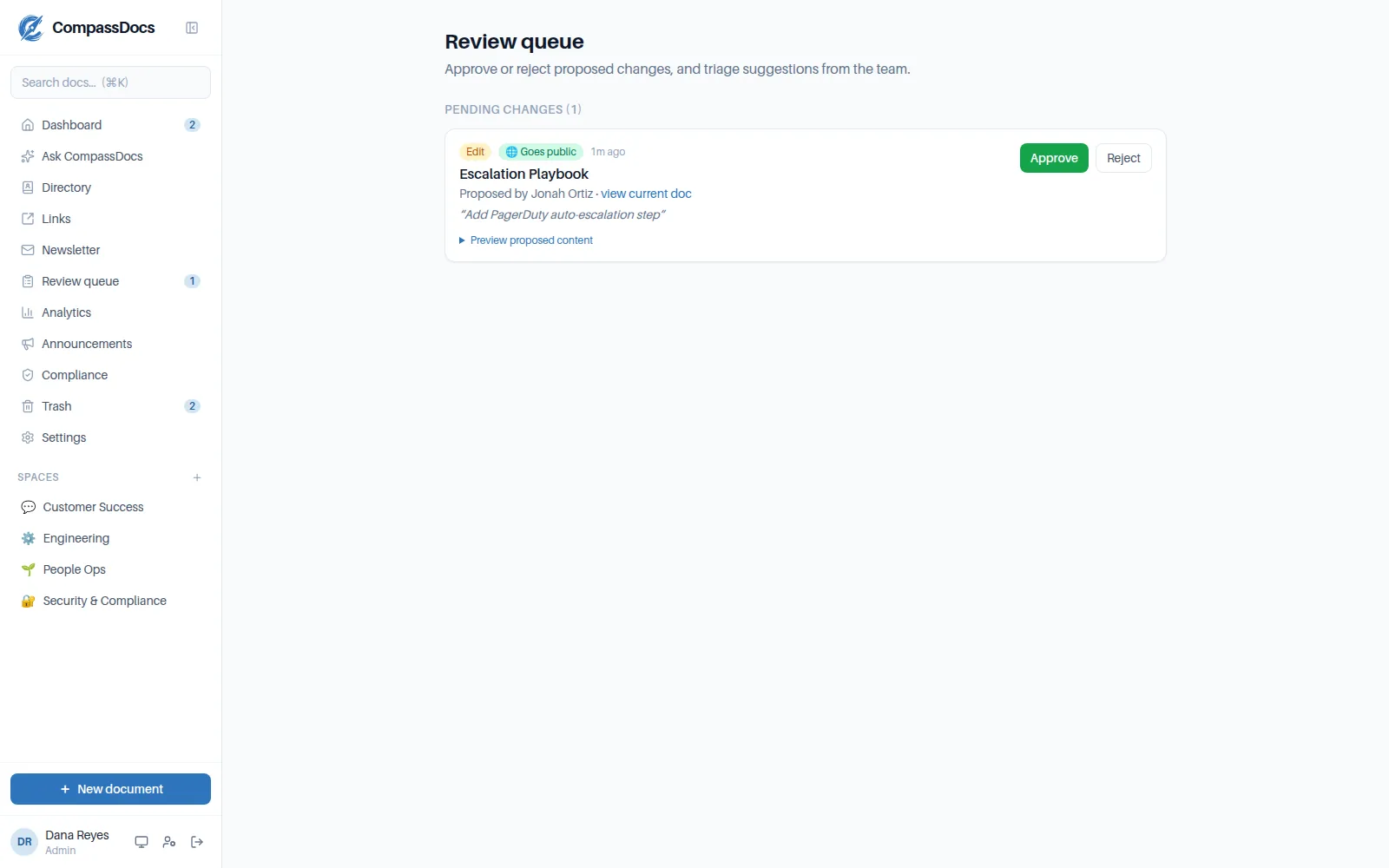
In CompassDocs, policies stay in their own spaces with their own owners and versions, and a handbook gathers them into numbered sections people read as one.
- Import the outline as front-matter Markdown, then write each policy as its own document
- Policy handbooks, in every edition: numbered sections, an introduction, and a printed copy with an acknowledgement page
- Version history, so you can show which version was in force on any date
- With Enterprise read confirmations, people confirm the whole handbook in one step, against the current version of each policy
- Private spaces for material only some teams should see; search and AI answers respect those boundaries
- With Enterprise training, turn the handbook walkthrough into a deck new hires get automatically
Frequently asked
Is this employee handbook template legal advice?
No. It is a generic structure with placeholders and contains no legal language. Employment law varies by location and changes over time, so have your finished handbook reviewed by HR and qualified legal counsel before you publish it.
What should an employee handbook include?
Most handbooks cover a welcome and company values, employment basics, working hours, pay, time off and leave, benefits, conduct and how to raise concerns, health and safety, information security, confidentiality, performance, leaving the company, and an acknowledgement. This template has a placeholder section for each.
How long should an employee handbook be?
Short enough to read in one sitting. Summarize each topic in a few paragraphs and link to the full policy, rather than reproducing every policy in the handbook itself.
How often should we update the handbook?
Review it at least once a year and whenever a policy, benefit or law that affects it changes. Record each version so you can tell which one an employee acknowledged.
Can we track who has read the handbook?
In CompassDocs, yes, with Enterprise read confirmations: people confirm the whole handbook in one step, and each confirmation is recorded against the version they read. Building, publishing and printing handbooks is in every edition.
Related: Employee handbook software · Policy handbooks · For HR teams · Read confirmations · Policy management
A handbook that stays current and gets read
Self-host CompassDocs free and build handbooks in every edition. Enterprise adds read confirmations, training and SSO from $499.99/year with unlimited users.
Self-host free See pricingBuying for a team? Get a quote · More free templates