 CompassDocs
A ServiceNow alternative for small and mid-size IT teams
ServiceNow is an enterprise platform for IT service and operations management, and for large organizations with heavy ITSM and ITOM needs it is hard to match. If you’re a smaller IT team looking for a ServiceNow alternative, CompassDocs gives you an internal service desk and the knowledge base your runbooks live in: self-hosted, open source, and sized for a desk of a few agents.
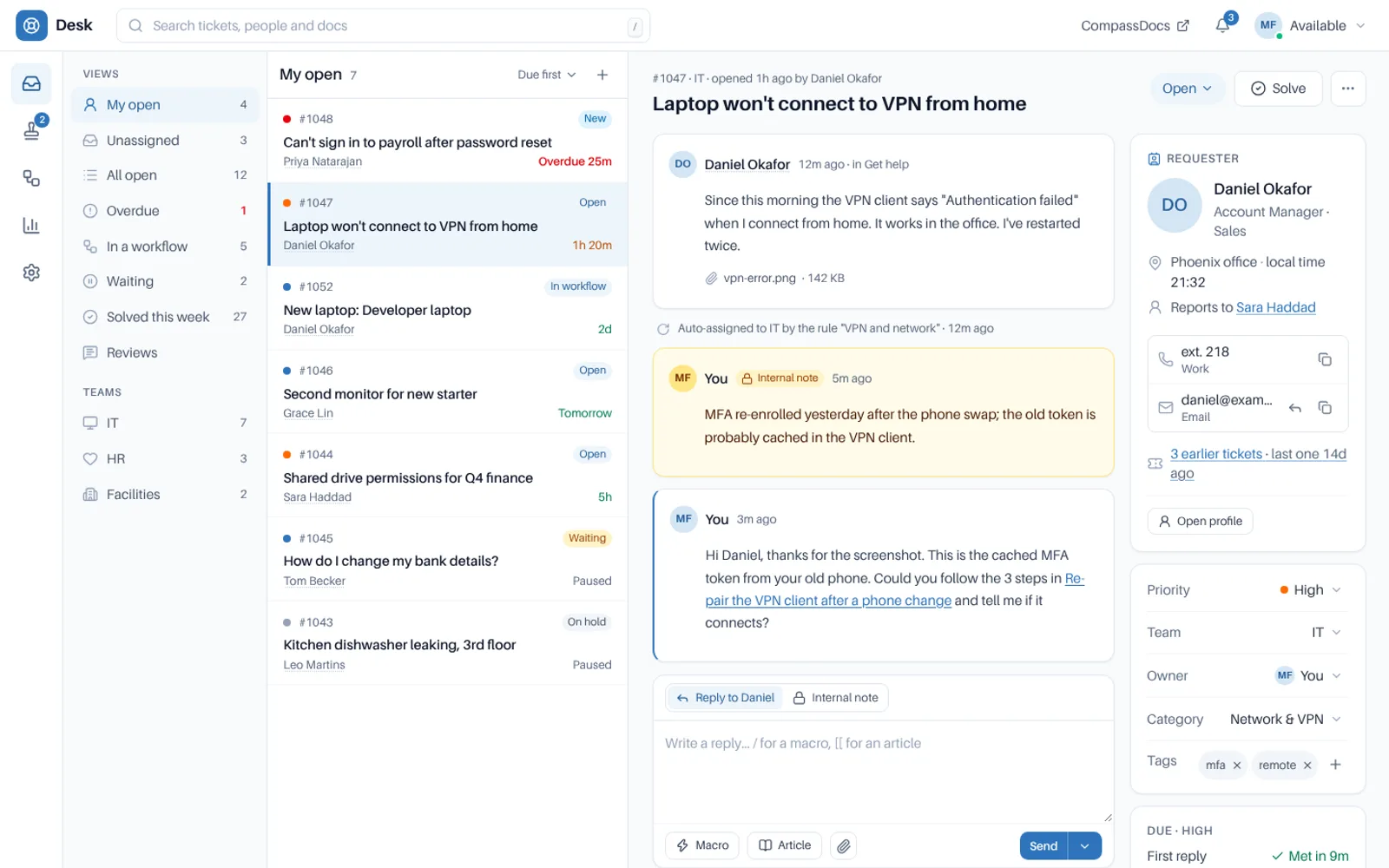
The desk: team queues with live counts, a split ticket view, internal notes and the reply-target clock beside every ticket.
Why smaller IT teams look for a ServiceNow alternative
- A yearly price that doesn’t grow with headcount: unlimited users, 3 helpdesk agents included and extra agents at $125/year each
- A five-step desk setup with a starter set, and every desk setting searchable by any word for it
- The desk and your runbooks in one product: agents and Claude search articles and solved tickets from the ticket they’re working
- Self-hosted on your infrastructure, with a signed offline license that works air-gapped
- Microsoft 365 throughout: mailboxes read through Microsoft Graph, Entra sign-in and SCIM, requests and approvals in Teams
The essentials of a service desk
Request types, workflows and approvals, SLAs in business hours, assignment rules and on-call rotas, automations and major incidents.
Assets on the ticket
Snipe-IT and Intune devices sync every 30 minutes, with warranty, compliance and earlier tickets, and requesters pick their own device when they ask.
Your servers, your data
Run the desk on infrastructure you control, with an offline-signed license that never calls home.
The service desk a small IT team actually uses
Most small and mid-size IT teams need a dependable front door, tickets that find the right owner, approvals that don’t stall, reply targets that respect office hours, and numbers for the monthly report. CompassDocs covers that ground in one self-hosted product, beside the knowledge base where your how-tos and runbooks already live.
Reports come with six built-in dashboards and over 30 measures counted in each team’s business hours; every chart opens its tickets, and any list exports as CSV. Five desk roles, from Newbie to Admin, are scoped to the teams people belong to, and a newbie’s replies wait for a team lead.
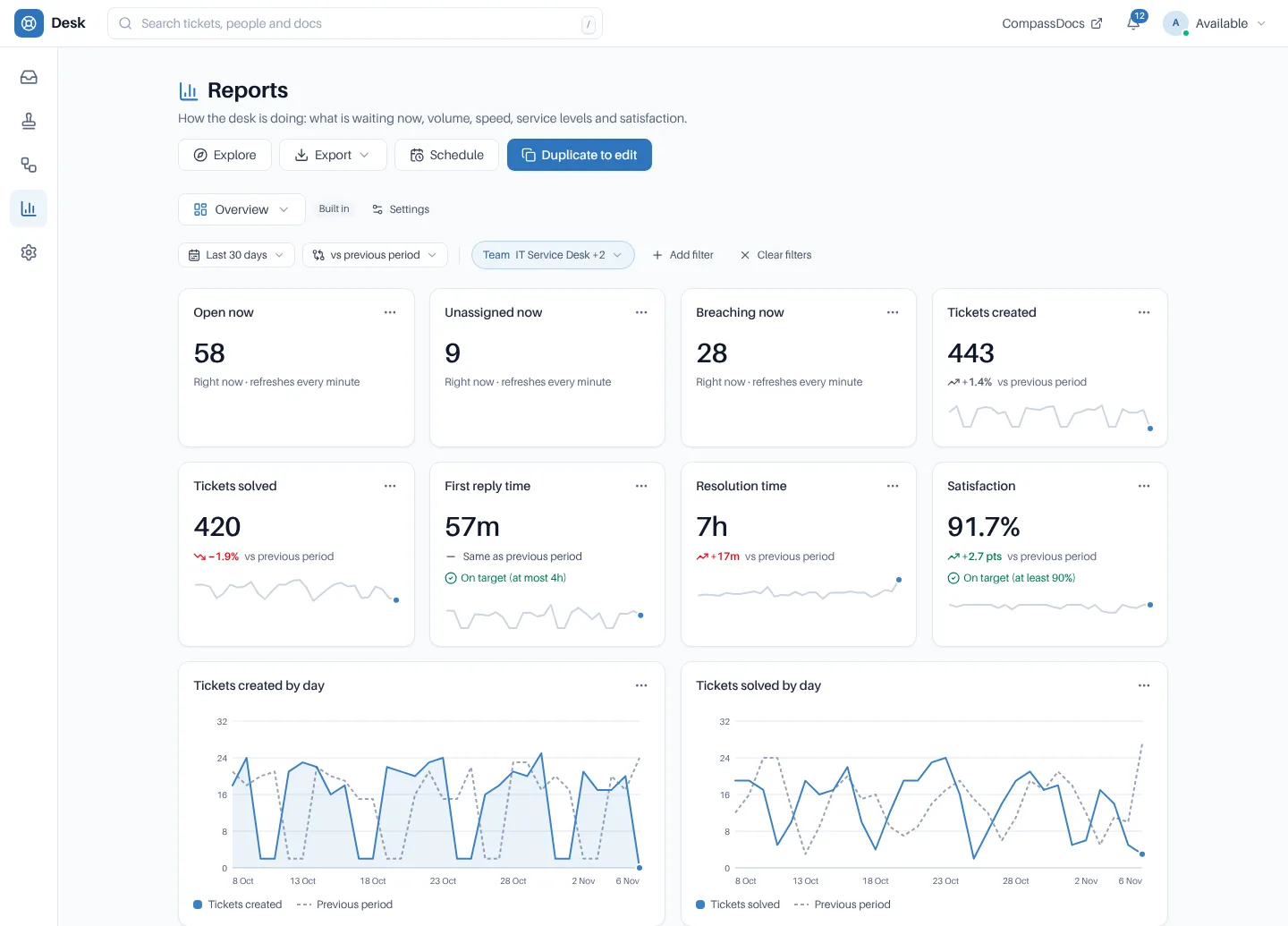
The Overview dashboard: open, unassigned and breaching tickets, reply and resolution times and satisfaction, compared with the previous period.
Workflows and approvals
Approvals from the directory, parallel tasks for several teams, waits and business-day due dates, tested with sample answers before you publish.
Major incidents
One ticket for an outage, one update to everyone affected, and a banner in Get help with a Me too button.
Alerts that open tickets
Prometheus Alertmanager, Grafana, Datadog and Azure Monitor open tickets; repeats become notes and a resolved alert solves the ticket.
Claude drafts, people send
Claude in the desk reads the ticket, searches solved tickets and your articles, and drafts a reply. An agent edits and sends it.
Microsoft 365 mailboxes
Shared or user mailboxes read through Microsoft Graph, with no forwarding rules, and replies that can appear in the mailbox’s Sent Items.
Built for the audit
Every desk change in the audit log, an optional Duo check before the desk opens, retention, legal hold and a recycle bin.
CompassDocs and ServiceNow side by side
Two very different scales. The comparison that matters is what a small internal IT team needs day to day.
| Compared | CompassDocs | ServiceNow |
|---|---|---|
| Main focus | Internal helpdesk for IT, HR and Facilities, with a full knowledge base | An enterprise platform for IT service and operations management, and many other workflows |
| Typical fit | Small and mid-size teams with a handful of agents | Large organizations with complex ITSM and ITOM needs |
| Hosting | Self-hosted on your servers, in your own PostgreSQL database | A hosted cloud platform run by ServiceNow |
| Source code | Open source, AGPL-3.0 | Proprietary |
| Pricing model | Community: free. Enterprise: $499.99/year per install, unlimited users, 3 helpdesk agents included, extra agents $125/year each | Enterprise subscription, quoted by ServiceNow |
| Knowledge base | Full team knowledge base: spaces, approvals, version history, templates and policy handbooks | Knowledge management within the platform |
| Service desk scope | Get help, the desk, request types, workflows and approvals, SLAs, automations, assets, major incidents and reports | Broad ITSM, including change and problem management, plus many other modules |
| Assets | Snipe-IT and Microsoft Intune devices synced onto tickets, with warranty and compliance | IT asset management and a CMDB on the platform |
| AI answers from your docs | Cited answers grounded only in your documents, with your own Anthropic key (keyword search is free). In the desk, Claude drafts replies and a person sends them | ServiceNow offers its own AI features |
| SSO | Enterprise: SAML 2.0 and OIDC, one-click Microsoft Entra setup, SCIM provisioning | Supported; see ServiceNow for details |
ServiceNow details describe its general model, not a specific product or plan. Check ServiceNow for current products, features and pricing.
When ServiceNow is the better fit
ServiceNow suits large enterprises. It is likely the better choice if:
You have heavy ITSM and ITOM needs
Formal change, problem and configuration management at scale, IT operations management and a CMDB that many teams depend on are what ServiceNow is built for.
You want one platform for many departments
If IT, HR, security operations and customer service are all meant to run on one deeply customized enterprise platform, ServiceNow is designed for that.
You don’t want to run servers
ServiceNow is a hosted service. CompassDocs Cloud isn’t open yet, so today CompassDocs means running it yourself: Docker, backups and updates.
Setting up the desk
The knowledge base is free to self-host; an Enterprise license turns on the helpdesk.
Run one command
The installer starts CompassDocs and PostgreSQL with Docker, and a setup wizard creates your admin account in the browser.
Bring your articles
Import guides and runbooks as front-matter Markdown into spaces for each team, or start from the built-in runbook and SOP templates.
Turn on the helpdesk
Add an Enterprise license (or a trial license), set up teams, request types and office hours, and connect help addresses or Microsoft 365 mailboxes.
Import ticket history
From a CSV file: map statuses, priorities and agents, check the dry run, then import in the background.
$ curl -fsSL https://raw.githubusercontent.com/Felix-AZ-Solutions-LLC/CompassDocs/main/install.sh | bash
  ✓ Fetched docker-compose.yml
  ✓ Generated .env with fresh secrets
  ▲ CompassDocs running at http://localhost:3000
  → open the URL to create your admin account
Requirements, platforms and the Node.js install path are on the self-hosting page →
Set up faster with Claude
CompassDocs is built for MCP, so Claude can do the first draft of your rollout while your team reviews and publishes. When you start, we walk you through it.
Bring your content in
Paste or attach the procedures and policies you already have, and Claude redrafts each one in your templates, screenshots included.
Draft the handbook and training
Claude assembles a draft handbook from your policies and, with Enterprise, turns procedures into training decks with quiz questions.
Configure the helpdesk as drafts
Request types, forms, workflows, macros and recurring tickets are drafted for an admin to review and publish. Nothing goes live on its own.
See everything Claude can do through MCP and the step-by-step rollout.
Frequently asked
Can CompassDocs replace ServiceNow?
For a small or mid-size internal IT team that mainly needs a service desk and a knowledge base, it can. For a large enterprise that runs formal change and problem management, IT operations management or a CMDB on ServiceNow, it isn’t a like-for-like replacement: CompassDocs isn’t a full ITIL suite or an ITOM platform.
How is the helpdesk priced?
The knowledge base (Community) is free and open source. The helpdesk is part of Enterprise: $499.99 a year per install with unlimited users and 3 agents included; each extra agent is $125 a year. Anyone can ask for help in Get help; only the people on the desk’s Agents list count as agents.
Does it handle HR and Facilities requests too?
Yes. Each team gets its own queues, office hours, request types and reply targets, and a workflow can send tasks to IT, Facilities and HR in parallel for something like a new starter. Desk roles are scoped to teams, so HR tickets stay with HR.
Can we bring our tickets and articles across?
Articles come in as front-matter Markdown. Ticket history can be imported from a CSV file, with statuses, priorities and agents mapped and a dry run before anything is written; the importer also reads Zoho Desk. There is no built-in ServiceNow importer.
Can it run without internet access?
Yes. The Enterprise license is a signed key checked locally on your server, with no license server to call. Features that talk to other services, such as Microsoft 365 mailboxes, Teams, Intune or Claude, need outbound access to those services.
Related: Jira Service Management alternative · Freshservice alternative · Reports & export · IT runbooks · Pricing
An IT service desk you host yourself
Self-host the open-source knowledge base with one Docker command. An Enterprise license adds the helpdesk, SSO and Microsoft 365 sync for $499.99/year with unlimited users and 3 agents included.
Self-host free Get a quoteWant to try the helpdesk with your own teams first? Request a trial license · See pricing
Need sign-off first? Build a business case deck with your own costs, free and with no sign-up.