 CompassDocs
An osTicket alternative for a modern internal helpdesk
osTicket is a long-standing open-source ticketing system that many IT teams run themselves. CompassDocs is an osTicket alternative that is also open source and self-hosted, with the helpdesk built into a full team knowledge base: request types and workflows, reply targets in business hours, assets on every ticket, Microsoft 365 mailboxes and Teams.
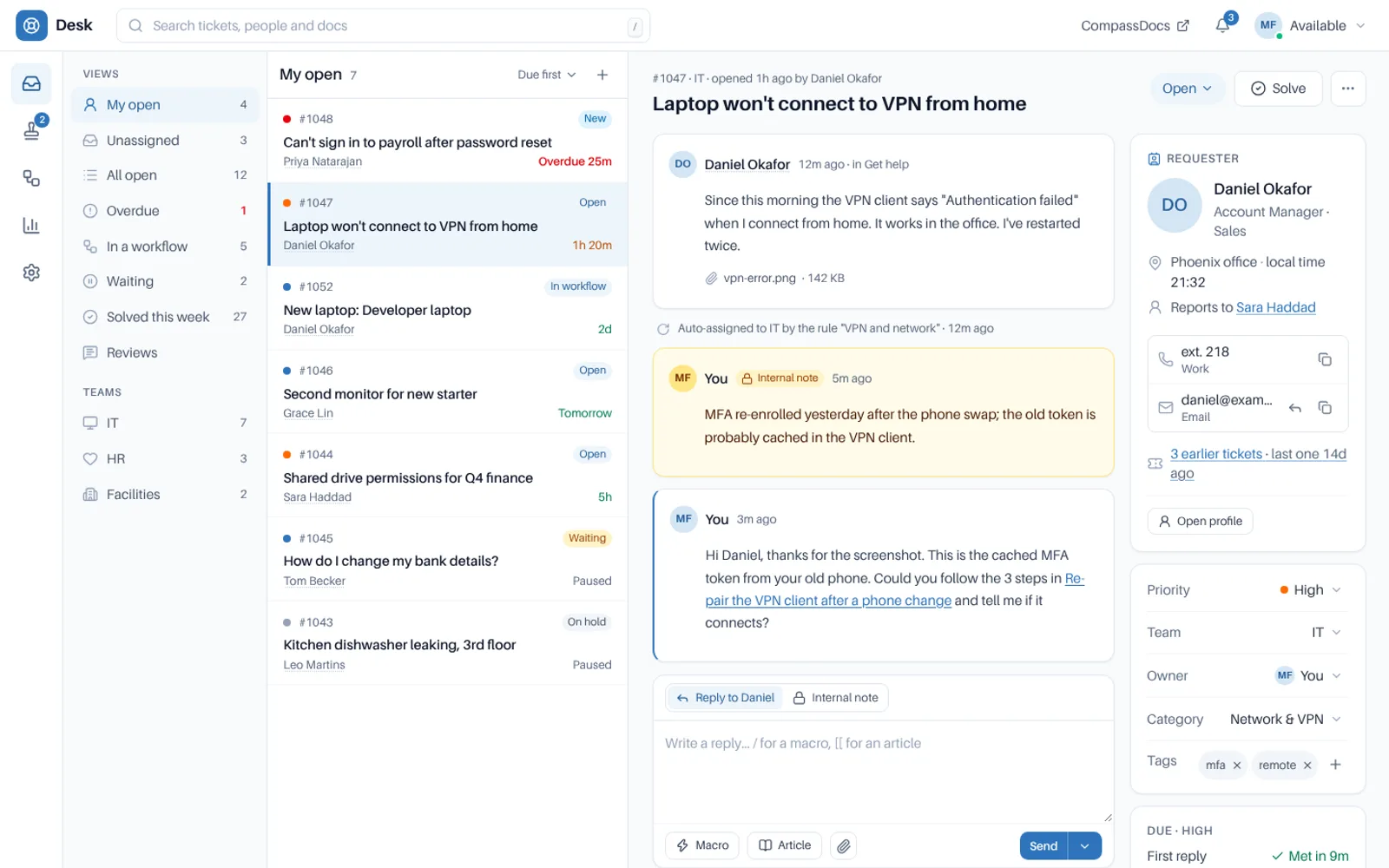
The desk: team queues with live counts, a split ticket view, internal notes and the reply-target clock beside every ticket.
Why teams look for an osTicket alternative
- Request types with forms that prefill from the directory, name the approver and can start a workflow
- Get help searches your guides before anyone sends a request, from the same knowledge base the desk works from
- A full-screen desk with live queues that installs as an app with push notifications
- Microsoft 365 throughout: mailboxes read through Microsoft Graph, Entra sign-in and SCIM, requests and approvals in Teams
- Reports with over 30 measures counted in each team’s business hours, and CSV export of any list
Still self-hosted
Like osTicket, CompassDocs runs on your own servers: Docker and PostgreSQL, on x86-64 or ARM64.
Assets on the ticket
Snipe-IT and Intune devices sync every 30 minutes, with warranty, compliance and earlier tickets, and requesters pick their own device when they ask.
Claude drafts, people send
Claude in the desk reads the ticket, searches solved tickets and your articles, and drafts a reply. An agent edits and sends it.
From a ticket queue to a service desk
osTicket does the core job of a ticketing system: email and web tickets, help topics, departments and SLA plans. Teams start to stretch it in the work around the ticket: a new starter who needs IT, Facilities and HR; an approval from the requester’s manager; a laptop whose warranty and compliance live in another console.
In CompassDocs, a request type can start a workflow of approvals, parallel tasks, waits and messages, built in the desk’s workflow builder and tested with sample answers before you publish. Assignment rules use round robin, load balancing, skills, languages and on-call rotas, and reply targets follow each team’s office hours and holidays.
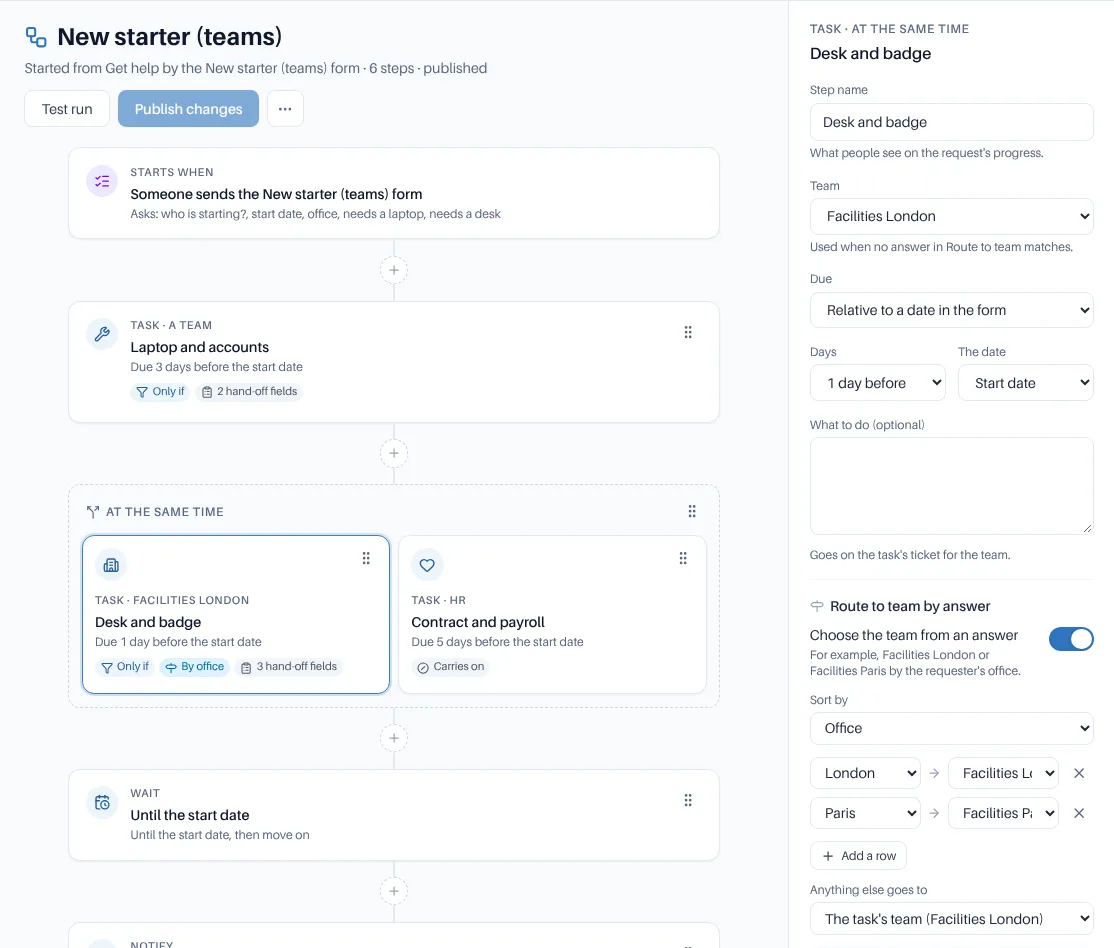
A New starter workflow: IT, Facilities and HR in parallel, then a wait until the start date.
Workflows and approvals
Approvals from the directory, parallel tasks for several teams, waits and business-day due dates, tested with sample answers before you publish.
Reply targets in business time
Office hours and holidays per team; targets pause while a ticket waits on the requester, with nearing and breach warnings.
Microsoft 365 mailboxes
Shared or user mailboxes read through Microsoft Graph, with no forwarding rules, and replies that can appear in the mailbox’s Sent Items.
Teams and Slack
People raise and follow requests by messaging the CompassDocs app, and approvers decide from a card in the chat.
Knowledge base and desk together
Spaces, version history and approval workflows come in the free Community edition; the helpdesk joins them with Enterprise.
Automations and macros
Rules that sort and answer tickets, macros and canned responses, and recurring tickets that open themselves on a schedule.
CompassDocs and osTicket side by side
Both are open source and self-hosted. Here is how they differ for an internal IT, HR or Facilities desk.
| Compared | CompassDocs | osTicket |
|---|---|---|
| Main focus | Internal help for IT, HR and Facilities, inside a full team knowledge base | A general-purpose support ticketing system |
| Hosting | Self-hosted on your servers, in your own PostgreSQL database (Docker, x86-64 or ARM64) | Self-hosted on PHP and MySQL, with a hosted version also available |
| Source code | Open source, AGPL-3.0 | Open source, GPL-2.0 |
| Pricing model | Community: free. Enterprise: $499.99/year per install, unlimited users, 3 helpdesk agents included, extra agents $125/year each | Free to self-host; paid hosting and support available |
| Knowledge base | Full team knowledge base: spaces, approvals, version history, templates and policy handbooks | A knowledge base of FAQs for requesters |
| Helpdesk | Enterprise: Get help, the desk, request types, workflows and approvals, SLAs, automations, assets, major incidents and reports | The core product |
| Workflows and approvals | Multi-step workflows with approvals from the directory, parallel tasks across teams and a test run | See osTicket for its current options |
| Channels | Get help, email (including Microsoft 365 mailboxes), Teams, Slack, a customer portal and monitoring alerts | Email, a web portal and an API |
| AI answers from your docs | Cited answers grounded only in your documents, with your own Anthropic key (keyword search is free). In the desk, Claude drafts replies and a person sends them | See osTicket for current options |
| SSO | Enterprise: SAML 2.0 and OIDC, one-click Microsoft Entra setup, SCIM provisioning | Available through plugins; see osTicket for details |
osTicket details describe its general model, not a specific version. Check osTicket for current features, hosting and pricing.
When osTicket is the better fit
CompassDocs isn’t the right tool for every team. osTicket is likely the better choice if:
You want a free helpdesk
osTicket’s ticketing is free to self-host. CompassDocs’ knowledge base is free, but the helpdesk needs an Enterprise license.
A simple queue is all you need
If a straightforward ticket queue already works for your team, there may be little reason to move.
Your stack is PHP and MySQL
If your servers and skills are built around PHP and MySQL, osTicket fits there. CompassDocs runs with Docker and PostgreSQL.
Moving from osTicket
The knowledge base is free to self-host; an Enterprise license turns on the helpdesk.
Run one command
The installer starts CompassDocs and PostgreSQL with Docker, and a setup wizard creates your admin account in the browser.
Bring your articles
Import guides and runbooks as front-matter Markdown into spaces for each team, or start from the built-in runbook and SOP templates.
Turn on the helpdesk
Add an Enterprise license (or a trial license), set up teams, request types and office hours, and connect help addresses or Microsoft 365 mailboxes.
Import ticket history
From a CSV file: map statuses, priorities and agents, check the dry run, then import in the background.
$ curl -fsSL https://raw.githubusercontent.com/Felix-AZ-Solutions-LLC/CompassDocs/main/install.sh | bash
  ✓ Fetched docker-compose.yml
  ✓ Generated .env with fresh secrets
  ▲ CompassDocs running at http://localhost:3000
  → open the URL to create your admin account
Requirements, platforms and the Node.js install path are on the self-hosting page →
Set up faster with Claude
CompassDocs is built for MCP, so Claude can do the first draft of your rollout while your team reviews and publishes. When you start, we walk you through it.
Bring your content in
Paste or attach the procedures and policies you already have, and Claude redrafts each one in your templates, screenshots included.
Draft the handbook and training
Claude assembles a draft handbook from your policies and, with Enterprise, turns procedures into training decks with quiz questions.
Configure the helpdesk as drafts
Request types, forms, workflows, macros and recurring tickets are drafted for an admin to review and publish. Nothing goes live on its own.
See everything Claude can do through MCP and the step-by-step rollout.
Frequently asked
Is CompassDocs open source like osTicket?
Yes. CompassDocs is open source under AGPL-3.0, and you run it on your own servers. The knowledge base (Community edition) is free. The helpdesk ships in the Enterprise image, and an Enterprise license turns it on.
How is the helpdesk priced?
The knowledge base (Community) is free and open source. The helpdesk is part of Enterprise: $499.99 a year per install with unlimited users and 3 agents included; each extra agent is $125 a year. Anyone can ask for help in Get help; only the people on the desk’s Agents list count as agents.
Can we bring our tickets and articles across?
Articles come in as front-matter Markdown. Ticket history can be imported from a CSV file, with statuses, priorities and agents mapped and a dry run before anything is written; the importer also reads Zoho Desk. There is no built-in osTicket importer.
Does it work with Microsoft 365?
Yes. With Enterprise, the desk reads shared or user help mailboxes through Microsoft Graph, sign-in uses SAML or OIDC with one-click Microsoft Entra setup and SCIM provisioning, and people can raise, follow and approve requests in Microsoft Teams. Intune devices can show on every ticket.
Can it run without internet access?
Yes. The Enterprise license is a signed key checked locally on your server, with no license server to call. Features that talk to other services, such as Microsoft 365 mailboxes, Teams, Intune or Claude, need outbound access to those services.
Related: Helpdesk · Workflows & approvals · Zammad alternative · IT helpdesk software · Pricing
A self-hosted helpdesk that knows your docs
Self-host the open-source knowledge base with one Docker command. An Enterprise license adds the helpdesk, SSO and Microsoft 365 sync for $499.99/year with unlimited users and 3 agents included.
Self-host free Get a quoteWant to try the helpdesk with your own teams first? Request a trial license · See pricing
Need sign-off first? Build a business case deck with your own costs, free and with no sign-up.